Texas State Park Protectors
- Vanessa Montenegro
- Jan 28, 2025
- 3 min read

Updated: Feb 11, 2025
In the summer of 2024, I chose to begin my senior capstone class early for my design management major. That summer, I also began hiking through Texas state parks, which sparked a newfound love for the outdoors. Throughout the 8-week course, we applied the design thinking process to our projects, and I concentrated on the theme of the outdoors.
Empathize:
During this phase of design thinking, we need to establish from the ground up what our project aims to resolve, who will benefit from it, and the reasons for addressing this problem. Our professor provided us with a list of global 'umbrella problems.' From this list, I selected environmental conservation and then developed a subset of what is included in conservation.

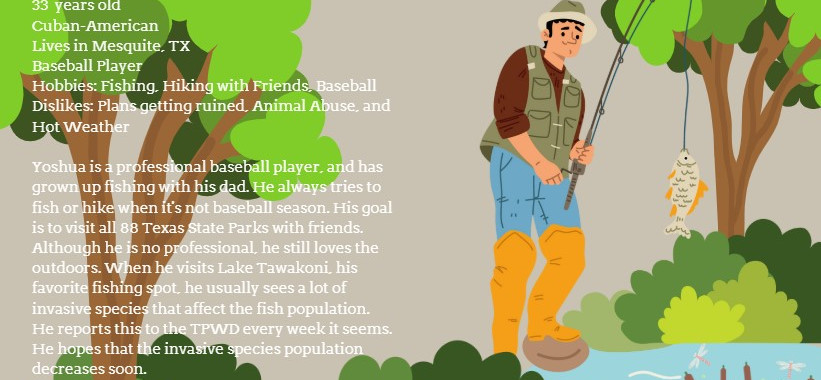
After deciding on the focus of my project, I moved on to the next phase: identifying the beneficiaries. Reflecting on my experiences hiking in state parks and often collecting litter to protect the environment, I realized the target audience was outdoor enthusiasts. I developed three user profiles based on research into individuals committed to preserving state parks. Whether they were passionate about fishing, hunting, hiking, nature photography, or were veterinarians, they all shared a common desire to prevent the degradation of these natural landscapes.



I recall having to respond to a discussion board question about why we were addressing this issue, and my answer was straightforward: I want to appreciate what nature has bestowed upon me, which is a sense of significance. Each time I traversed a muddy, slippery, or dry trail up a hill or mountain, I felt a sense of importance. Not for myself, but for the Earth and its capacity to sustain life. The beauty of it all motivates me to persevere, regardless of circumstances, because the Earth, despite its condition, continues to spin. During every hike, I encountered a plastic wrapper or bottle discarded near the river or on the hillside, and it was deeply frustrating to witness the indifference of others.

Define:
I needed to define the project by connecting the what, who, and why, addressing their needs and problems. My research focused on identifying the parks closest to Dallas, including their geography, history, culture, transportation, demographics, economy, and tourism. Using this information, I created a booklet to outline how the project would aid in conserving Texas State Parks. I decided to focus on protecting state parks near Dallas, such as Cedar Hill, Robert Ray Lake, and Lake Tawakoni. Ultimately, I chose my target audience to be outdoor enthusiasts of all ages and individuals passionate about proper conservation.

Ideate:
Since I began hiking, I started following numerous outdoor enthusiasts on social media to gather tips on enjoying the outdoors safely. I also learned several tips on leaving no trace at parks, ensuring others can fully enjoy the outdoor experience. Gradually, I merged the concepts of social media and conserving state parks. I explored content on how to leave no trace in any outdoor activity and was surprised by the abundance of information available. Even the state parks had their own social media presence to discuss clean-up hikes or park events. This inspired me to establish a social media platform aimed at informing and building a community centered around state parks.

Prototype:
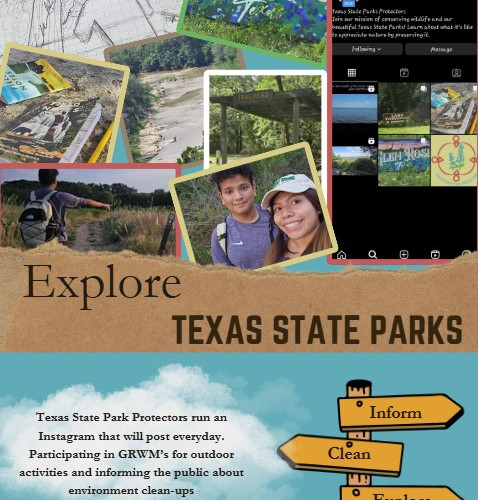
Thus, my prototype would evolve into a social media channel dedicated to informing the audience about protecting Texas state parks. It would foster a community of volunteers willing to assist. I developed social media calendars as a test to evaluate its functionality and viewer engagement. Additionally, I created a digital flyer to introduce the social media platform, offering the audience insight into how the organization would operate. By examining real-world organizations that collaborate with state and national parks, I gained an understanding of its potential workings.


Test:
Independently, Texas State Park Protectors might not achieve the desired level of audience and engagement. Therefore, partnering with the official Texas state parks' social media page would be necessary. Testing this out, I did end up getting a few more followers and engagement to my posts. Which showed me that if an organization like mine were to partner up with the Texas State Parks, it would realistically succeed in getting engagement on social media.
Reflections:
During the process, I explored many more state parks and began to understand why people work to preserve beautiful areas. I documented my hikes with my partner and collected any litter I encountered. This project felt incredibly meaningful to me, and researching it was my favorite part. It also intertwined with my career passion, as I was able to apply my social media skills to the project.
Here is a link to my final brand book:

Comments